Once again, you can find my latest theory & craft article not here on scribbler, but published in Creative Screenwriting Magazine (their site design is much nicer, anyway).
The follow-up to my last article, this one delves even deeper into the cinematic audience's three levels of psychological need (the intellectual, the emotional, and the visceral) by showing how great storytellers manage to drive audiences nuts with fear, anxiety, and pleasure by creating conflicts between those needs. Films studied are Alien (the visceral vs. the intellectual), Rocky (the visceral vs. the emotional), and The Godfather (conflict between all three). Plus, you get to see my insanely handsome picture. You know you want to see it.
Thursday, April 16, 2015
Sunday, April 12, 2015
SCRIPTMONK Goes to the Movies: WHIPLASH -- An Intimate "Small Man Rises"
I admit I'm
a little late to the party on this film. Whiplash
was released in theaters way back in January and has since
collected three Oscars, but it can still be seen in select theaters
and is now available on video, so I highly recommend checking it out
if you have not already.
Whiplash,
by all traditional measurements was a sleeper hit. A small-budget
independent film, no A-list actors in the cast, and a premise which
does anything but scream high-concept. Though a lot of credit it owed
to its great performances and the amazing on-screen musical skill of
its star Miles Teller, the secret to the film's success as a work of
storytelling originates from the fact that it takes a tried-and-true
(and due to its constant overuse in Hollywood, all-too-familiar)
narrative Plot Pattern and renders it almost unrecognizable to the
viewer into something which seems altogether fresh and new. Whiplash
manages to nail what often seems
to be a contradictory demand made of writers and filmmakers, to “give
something new, yet familiar.” Though the film's surface content may
seem to be material which seems rarely if ever explored in a major
feature film, under that surface Whiplash
follows a specific and distinctive Plot Pattern (also known on this
blog as a “Story Type”) which we have all seen and enjoyed many
times before.
I
am referring specifically to the “Small Man (or Woman) Rises”
story type, the second of my 20 Common Plot Patterns as found in Hollywood and American Independent feature films. This pattern is
defined as such:
A more or less unremarkable protagonist is selected by an outside
power to fulfill a role through which he or she is expected to
achieve greatness. Unprepared and often unwilling to fill this role,
the protagonist first requires the guidance and nurturance of
supporting characters to expose and eliminate the flawed attitudes or
behaviors that block the hero's path to greatness. Later developments
present a series of tests which force the hero to recognize and then
prove his or her great potential value, usually failing before
finding success.
The
key defining traits of this plot pattern are first that the hero is
chosen by an outside power
to participate in the story's quest. Second, the hero's strongest
obstacle is not physical, but internal; usually a flaw in
the hero's sense of self-worth, value to the world, or personal
identity.
This
plot pattern can be further broken down into two subtypes:
The
Summoned Hero
An
inexperienced hero is plucked from obscurity by a higher power to
fill a role of great importance. Mentors and other supporting
characters nurture the hero in preparation for a final confrontation
with a force of antagonism in which the hero must finally prove his
or her worth. (Examples: The Matrix, Men in Black, Silence
of the Lambs, Kung-Fu Panda)
The
Breakaway Hero
A hero is ushered into a system or given an opportunity through which
he or she is promised fame, glory, or great personal achievement.
However, the protagonist comes to realizes this system is not acting
in his or her best interests, often using him or her for its own
questionable purposes. The hero then breaks away from the system
(often inciting open conflict between the two), whereafter he or she
transforms into an independent hero fighting for his or her own
personal cause. (Examples: Batman Begins, Rocky, 12 Monkeys)
The most obvious difference between these two subtypes is that, in
the Summoned Hero, the protagonist has a positive relationship with
those who have chosen him or her for the role, while in the Breakaway
Hero, the protagonist develops an antagonistic relationship,
ultimately standing against the mentor/higher power in direct conflict.
Plotwise, Whiplash belongs to the second subtype. Its
protagonist Andrew Neiman (Miles Teller), an ambitious young drummer
at the Shaffer Conservatory of Music, is plucked from obscurity by
revered instructor Terence Fletcher (J.K. Simmons) to join the Studio
Band, Shaffer's elite group of musicians. However, Andrew soon
realizes that Fletcher is not a benevolent, nurturing mentor, but an
ogre and a tyrant who (much like Ra's Al Ghul in Batman Begins)
uses harsh methods to mold and warp Andrew into the type of person
Andrew did not formerly wish to become. (See this previous article
for more information on mentor-antagonist relationships.) Due to the
love-hate relationship found between protagonists and such
mentor-antagonists, Andrew tries to meet all of Fletcher's
unreasonable expectations, but eventually rebels against this
treatment, turning into Fletcher's enemy and ultimately defeating
Fletcher to become an independent hero living on his own terms based
on his personal standards of greatness.
As seen in the other examples of Small Man/Woman Rises narratives
listed above, this plot pattern usually lends itself to stories with
fantastic premises or those with protagonists put into extraordinary
situations. Whiplash, however, is noteworthy for adapting this
form to a premise which is much smaller and more personal, one
the audience can better relate to their own
struggles for worth and accomplishment. Whiplash gains its
dramatic impact by taking a superhero-type narrative and placing it
into the far more accessible context of the everyday; into a
coming-of-age tale of growth and maturity with which the audience can
directly identify.
An essential part of the Small Man/Woman Rises is the way the greatest obstacle
standing in the protagonist's path to victory comes not so much the
force of antagonism, but the protagonist's own Fatal Flaw. The “Fatal
Flaw” is a concept often misunderstood among developing
storytellers because it is often addressed with so much
vaguery. The Fatal Flaw is always psychological. All of the
protagonist's negative or self-defeating traits arise from a warped
or incorrect paradigm – that is, a system of beliefs which negatively influence how the
character sees him or herself, others, or the world in general.
Andrew's Fatal Flaw is that he suffers from what psychologists refer
to as an “external locus of self-worth.” This means Andrew views
his personal value not on his own terms, but based on approval
received from someone or something outside of him. Namely, Andrew judges his own value insofar as he can receive
Fletcher's approval. Because of this, Andrew willingly puts up with
all of Fletcher's abuse because Andrew can only receive a sense of self-worth from that very same abusive mentor. This however proves
to be an absurd quest as Fletcher will never, ever give Andrew praise
no matter how hard he works or how much he is willing to give. But
Andrew does not realize this, and like a hamster on wheel, keeps
charging harder and harder after what he will never receive, becoming
miserable and destroying himself in the process. If Andrew is ever to
find success or happiness, he must first abandon his flawed paradigm
in favor of one which is healthier, more productive and more
accurately reflects the truth of the world in which he lives (a
process known in screencraft as conversion or value
realignment). Andrew must shift away from an external locus of
self-worth to an internal one, one where his sense of personal value
is based on his own standards rather than any imposed from outside.
Conflict is always the key to character change. Conversely, character
change is always the key to overcoming that conflict. They are two
problems which solve each other. Andrew's external locus of
self-worth drives him in reckless and obsessive pursuit of Fletcher's
impossible standards. But by following his flaw, Andrew is pursuing
his goals the wrong way. His actions do nothing to solve the
conflict, rather they only make it worse. Continually denied what he
desires, Andrew eventually snaps, attacks his mentor, and in the
process loses everything he has so far struggled to achieve.
Fortunately, these mounting failures provide Andrew with a mountain
of evidence that, once reflected upon, lead Andrew to a moment of
self-revelation. He comes to realize that it is foolish and
self-defeating to bank his sense of personal worth on the approval of
a person who is too cruel and indifferent to give it. True self-worth
can only come from oneself. To be at peace with one's own
value, a person must set their own standards of accomplishment and then
pursue those standards for no one's approval but one's own. So, like
the title character of Rocky (another Breakaway Hero
narrative), Andrew reevaluates his goals and sets new objectives through
which he can achieve a sense of worth on his own terms. By shifting
from an external locus of worth to an internal one, Andrew finds the
strength of will to finally stand up to and ultimately defeat his
oppressor; not by playing by Fletcher's rules, but by his own.
In the end, like in other Breakaway Hero narratives, Andrew stands on
his own two feet as an independent hero who find greatness by acting
according to his own personal values and beliefs.
“There are no two words in the English language more harmful than
'good job'.” This is the philosophy that Fletcher lives by. Though
this may sound cruel, Fletcher does make a good point. By withholding
praise, Fletcher pushes Andrew to become the best he can
possibly be. But as the narrative plainly shows, this has both a
positive and a negative impact upon Andrew's struggle for
accomplishment. By combining Fletcher's philosophy with Andrew's
absurd quest for approval, the whole of Whiplash is unified by
a thematic message on the potential damage of an external locus of self-worth (even if the attention received from the
external locus is positive). As long as someone lives their life by
another person's standards, their life will be limited by those
standards. If those outside standards are too low, the individual
will stop once they are reached and may never realize their full
potential. If on the other hand, the standards are impossible to
reach, the individual will live in constant misery. Through the
pressures of the story conflict, Andrew transforms his
character and in the process learns (along with the audience) a valuable lesson about leading a healthy and productive existence. Though its story may be small and intimate, though
its content may seem very different, Whiplash brings the same
emotional impact as films like Rocky, Batman Begins, or
other Breakaway Hero narratives by following the same structure and
delivering the same basic message: true heroes first accomplish
greatness by finding the will to stand on their own two feet and base their
actions on their own personal standards, values, and beliefs.
Saturday, January 3, 2015
James Bond and the God Narrative
(The following articles was adapted from a rough excerpt of my upcoming new book Screenwriting and the Unified Theory of Narrative from a section entitled "Alternative Structures.")
It never fails. Whether it be
online or in person, in the classroom or elsewhere, whenever someone
well-versed in the basic principles of screencraft tries to express
certain seemingly-unbreakable axioms of traditional narrative
structure, particularly those of the protagonist's character arc,
someone inevitably challenges those statements with the same dreaded
question: What about James Bond? The “Bond Conundrum” has plagued
dramatists for decades. James Bond is inarguably one of the most
successful movie heroes of all time, yet the portrayal of the
character seems to ignore many of the rules and qualifications
usually deemed mandatory for a successful cinematic protagonist. As
anyone familiar with screencraft should know, the protagonist's
character arc is an essential component of the cinematic story's
overall narrative structure, one which the other components
interrelate and rely upon for the sake of development and completion.
Yet in the Bond films, the protagonist does not seem to possess any
identifiable character arc. He does not undergo a process of internal
change in reaction to the plot's events. He does not seem to have any
clear fatal flaw nor does he pursue an Internal Need. This by large
holds true for the supporting characters in these films as well.
(This analysis excludes the more recent incarnations of the Bond
franchise, starting with 2006's Casino Royale
which attempt to humanize the Bond character by putting him in a more
traditional mold. For this reason, these films do not pertain to this
discussion.)
The
commonly-offered explanation is that the Bond films have stood apart
in the industry by existing from their start as an
intentionally-serialized franchise, each instance acting more like
episodes in an ongoing television series rather than the individual
stand-alone and self-contained narratives we see in other films. This
requires the Bond franchise to contain a stable, unchanging cast of
characters that can be placed in one adventure after another and
always return in the end to the status quo so that, like in
television, the episodes can be enjoyed in any order without
confusion. Unfortunately, this argument does not explain why the very
first appearances of Bond in the films Dr. No (1962)
and its follow-up From Russia With Love (1963)
were originally successful as stand-alone narratives. Without the
individual audience approval of these first installments, the
serialized franchise would have never launched in the first place.
This seems to suggest that the secret of Bond's success, in spite of
its infractions upon the standard rules of cinematic storytelling,
lies elsewhere, presumably in the structure of the individual films
themselves.
To
find an answer, it is important to note that as a character James
Bond does not in any way seem to be a common mortal man. Nor is he
even the exaggerated or figurative depiction of a mortal man as often found in stories with highly fantastic settings or premises.
James Bond is super-human. He is even more super-human than the likes
of Superman or Hercules, as these heroes still struggle with “human
issues” such as internal flaws, ethical dilemmas, or their own
personal limitations. James Bond struggles with none of these. Bond
is endlessly capable and endlessly self-confident. He never shows
fear, never shows doubt, and never loses control of his emotions.
Bond does not think, he simply acts – without a moment wasted
debating the correctness of those actions.
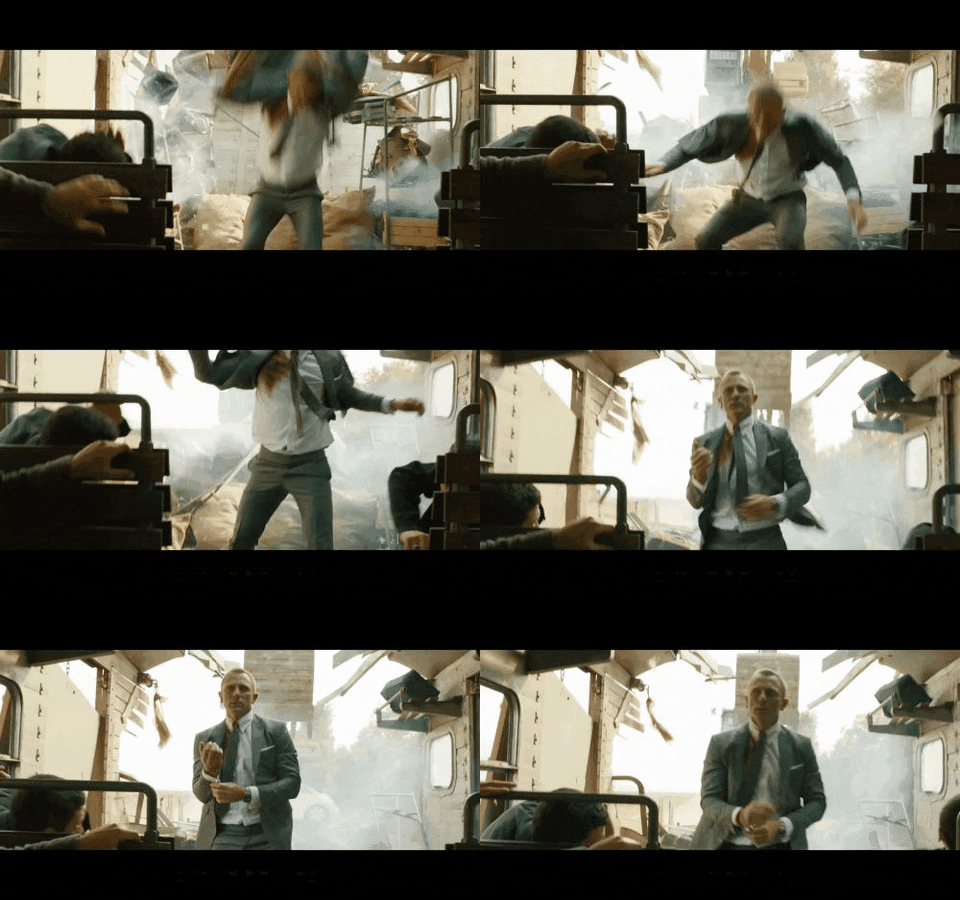
![]() |
| No sweat. Just an average day here. |
In
considering all of this, my chain of thought--for reasons I
cannot remember--led me to the ancient Greek, Roman, and Scandinavian
myths I read in my youth. These myths are generally of two types
(with the exception of creation or cosmological myths). The first are hero myths; stories of a mortal man or woman who dares in some
way to challenge the gods. This, by various stretches of the
imagination, can be considered the form that the vast majority of
cinematic stories follow today. The second type are myths about
the gods themselves, in which mortal men play a minimal or
nonexistent part. These myths are typically broad in scope, yet
fairly shallow in meaning; composed of tales of gods conflicting
with the fickle whims of other deities, supernatural monsters, or
other entities, reaching a conclusion which somehow acts to reclaim
the order and balance of the universe.
The
behavior and personality of James Bond is very much like that found
in the gods of these myths. Bond himself may be considered a
modernized depiction of a god character for several reasons. The
first is the effortless skill with which he achieves all things.
Second, like a god, his character is eternal and unchanging (the
actors who play him may change, but the character essentially remains
the same). Third, unlike most movie heroes, Bond has an implied
immortality. In most action sequences, dramatic tension emerges
from the audience's fear that the hero will meet serious harm.
However, this fear is never truly present in the Bond films. The
audience is always certain that James Bond will find a way to survive
no matter how threatening the situation. Finally, and most
importantly, Bond never struggles with any kind of questions, ethical
or otherwise, regarding his actions. He seems to instantly know the
correct path and takes it as if by supernatural instinct.
![]() |
| Oh, please. You're only amusing him. |
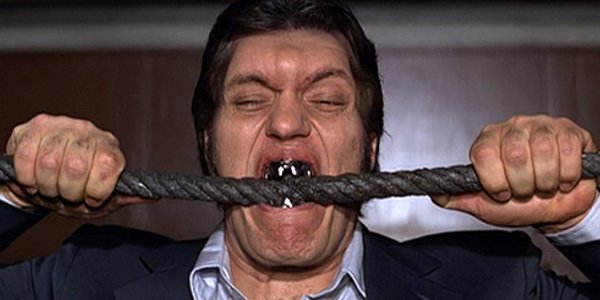
![]() |
| gods... |
| and monsters... |
Of
course, a theory requires more than one example to hold any water.
God narratives are rare, but others do exist. The 1966 Western The
Good, the Bad, and the Ugly
follows the samesuch form. Its protagonist (played by Clint
Eastwood), a man with no name but the nickname
“Blondie,” is another god-hero.
"Blondie" is endlessly capable, endlessly confident, and devoid of strong emotion or moral quandaries. The fact that, unlike Bond, Blondie is a self-serving antihero concerned only with his own wealth does not taint the argument. If one remembers their mythology, it should be recalled that while some gods are benign or hostile towards mankind, most are indifferent to the existence of man and its morality, acting largely to serve their own pleasures. Indeed, Blondie behaves as if he is both outside and above the world of the common man. Neither their worries, their causes, nor even their law are of any concern to him. His only real struggles comes from the constant tricks and treachery played on him by the story's two other larger-than-life beings; the impish trickster Tuco and the shape-shifting devil Angel Eyes – two characters with their own mirrors in mythology.
Blondie's character does not change. Like a deity, his character is eternal and unchanging. This is principally because he had no need to change. Blondie's physical abilities are already perfect, therefore no flaw could exist to interfere with them. As an “idealized being” of his place and time, he essentially lacks nothing. So, unlike a traditional hero, he has no Internal Need which he must pursue to improve as an individual. In times of trouble, Blondie never needs to question whether his past behavior is to blame or seek moral guidance in the future. Each event is merely another up or down in an eternal battle of good and evil. Even when things are at their worst, Blonde is usually rescued by some random twist of fate, suggesting that there is some cosmic order in which he hold a part.
"Blondie" is endlessly capable, endlessly confident, and devoid of strong emotion or moral quandaries. The fact that, unlike Bond, Blondie is a self-serving antihero concerned only with his own wealth does not taint the argument. If one remembers their mythology, it should be recalled that while some gods are benign or hostile towards mankind, most are indifferent to the existence of man and its morality, acting largely to serve their own pleasures. Indeed, Blondie behaves as if he is both outside and above the world of the common man. Neither their worries, their causes, nor even their law are of any concern to him. His only real struggles comes from the constant tricks and treachery played on him by the story's two other larger-than-life beings; the impish trickster Tuco and the shape-shifting devil Angel Eyes – two characters with their own mirrors in mythology.
Blondie's character does not change. Like a deity, his character is eternal and unchanging. This is principally because he had no need to change. Blondie's physical abilities are already perfect, therefore no flaw could exist to interfere with them. As an “idealized being” of his place and time, he essentially lacks nothing. So, unlike a traditional hero, he has no Internal Need which he must pursue to improve as an individual. In times of trouble, Blondie never needs to question whether his past behavior is to blame or seek moral guidance in the future. Each event is merely another up or down in an eternal battle of good and evil. Even when things are at their worst, Blonde is usually rescued by some random twist of fate, suggesting that there is some cosmic order in which he hold a part.
Like
the Bond films, the conclusion of The Good, the Bad, and
the Ugly does not suggest that
the hero's adventures have wrapped up and come to an end as they do
in most feature films. This story seems only to have been a brief episode in an
endless saga which will continue for the hero, though we never get to see most of it. The film's end is merely a pause in the
existence of its unchanging god-hero.
A god narrative of a far difference character can be found in Forrest Gump. While The Good, the Bad, and the Ugly presents only a few episodes in a suggested saga, Gump shows its hero's saga in it near entirety. Gump's narrative presents a very non-traditional structure composed of a series of adventurous episodes, one after another. The only thread which holds Gump together into anything suggesting a traditional three-act form is the one story element which never changes: Forrest's continuing desire to find Jenny and make her his love. The rest of the film, in its epic saga form, depicts little more than the many ways an immortal god-hero like Forrest chooses to fill his time while waiting to meet his Jenny again.
It
might be difficult to imagine Forrest as a god-hero. However, his
character demonstrates the same non-traditional qualities as James
Bond or Blondie. First, by way of his slow-witted and simple
nature, Gump perpetually exists outside of the world of the common
man. He walks among them, but he is not one of them. Forrest's
simple-mindedness actually has the effect of elevating him above
others into a virtuous being. He cannot lie. He cannot hate. He cannot
understand the petty arguments, prejudices, greed and anger which
often consume the common mortal's life. He can almost be considered a
being without sin. Second, one cannot deny that Forrest's physical
skills border on the supernatural. He has the speed to become a
college football All-American with no major effort. He has the
strength to carry five Army buddies to safety. He becomes a
world-class ping pong player only months after first picking up a
paddle. He's the only captain with the skill to keep his shrimp boat
from being destroyed in a hurricane. The examples go on and on.
Third, Forrest has an implied immortality, both in a physical and
a metaphysical sense. He is not only immortal in body, as he survives
Vietnam and the hurricane, but immortal in spirit. As the decades
pass, Gump's exploits pop up in the national media again and again,
as if he were some sort of cosmic thread uniting American
history. Fourth and most importantly, like Bond and Blondie, Forrest
never suffers any ethical dilemma or confusion over what actions to
take. Thanks to his simple mind and pure heart, he does not think; he
simply does and always comes out in the right.
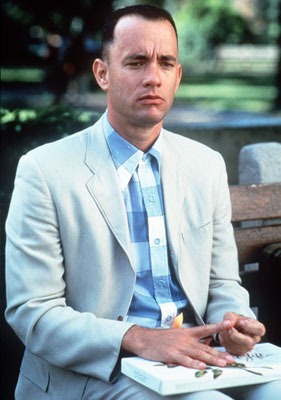
![]() |
| Isn't it weird how I keep showing up at these things? |
As
a character, Forrest Gump does not have any fatal flaw which he must
overcome. Though his naivete and childish innocence do pose
difficulty, this
is not a fatal flaw in the traditional sense. First, this behavior is part of
Forrest's innate nature; a trait which cannot be changed.
Second, this “flaw” is actually Forrest's greatest virtue, since
his innocent mind is the tool which leads him time and again down the
correct paths to overcome conflicts and succeed with hardly any
effort.
The
Bond franchise, The Good, the Bad and the Ugly
and Forrest Gump. Here
we have three examples of highly-successful films of non-traditional
structure in which the protagonists all share the same unusual heroic
traits. These successes are not freak occurrences in the one-and-only
monostructure of cinematic storytelling, but evidence which suggests an
alternate form of structure; one with significant parallels to the god narratives of myth – perhaps even providing a
modern evolution of these tales. However, any further understanding
of this structure and how it functions will require further
investigation and hopefully uncover many more examples of its type.
Sunday, November 23, 2014
New CS Article! -- "Visceral Storytelling"
Though new articles have been slow in coming here on scribbler, please check out my most recent article published in Creative Screenwriting Magazine!
The article introduces the cinematic audience's three levels of psychological need; the intellectual, the emotional, and the visceral; and then uses a popular theory on human brain evolution to explain why this is and why, among the three needs, the visceral is most important when it comes to providing an exciting and dramatically-satisfying story experience. A must-read for any dull script that cannot seem to grab reader excitement in the way it should.
Saturday, September 27, 2014
Sorry about the lack of new articles
I know, I know. New content has not been showing up as regularly on this site as it used to. But hopefully I have an acceptable excuse. I am currently working on my follow-up book to Screenwriting Down to the Atoms, and thus all my ideation and creativity has been poured into that as of late. This book will be on advanced topics, this time only containing the ideas and methods I have developed personally. I will try not to starve scribbler entirely, however. I would like to do some more Scriptmonk Goes to the Movies articles. They're fun and informative, and come pretty natural since I always leave the theater wanting to rant about something anyway. But if only the Hollywood will bother to offer me something worth leaving the monastery and seeing... Book updates will be forthcoming, with no doubt a sample chapter or two posted by the end of the year.
scribble on.
scribble on.
Thursday, September 11, 2014
The Humility Arc
Follow the link below to read an article I recently wrote for Creative Screenwriting Magazine. The topic is the "Humility Arc," a new concept of mine I consider to be one of the most significant discoveries I have made since publishing Screenwriting Down to the Atoms.
The Humility Arc finds in a most unlikely source an elegantly simple structure which all evidence seems to suggest has been adopted with near-universality into the Hollywood feature film, providing a fundamentally simple and easy to understand perspective on the concept of the Character Arc and its relationship to the story.
Wednesday, August 6, 2014
Learning Movies By Watching Movies: Watching FAST and Watching SLOW
WATCHING MOVIES FAST
I like to watch movies in
fast-forward. Not the first time, of course. There would be little
point in that. Rather, when studying a film in order to learn from
it. Strange as it may sound, I recommend this as something you should
try as well.
I originally started to do this
as a way to save time. Whenever I am preparing a blog article or have
a particular area of screencraft I wish to study, I always have to
re-watch three, four, sometimes up to a dozen films for research. But
frankly, I don't have that much time in my day. Movies are long. So
to cut down on research time, I began to take advantage of a feature
on my laptop's movie player that allows playback at 1.5x speed (50%
faster than usual) without muting the soundtrack. That way, I could
still watch every moment of the film in only 2/3 the time.
However, I soon noticed a
surprise additional benefit to this. If I was examining these films
for anything to do with plot, story structure, or character arc, I
found I could see the shape and course of such things quicker and
easier than I could have by watching the same film at normal speed.
One difficulty that stands in the way of the developing screenwriter
who attempts to learn more by watching other films is a feature
film's length. To the uninitiated, feature films appear to be such
wild, complicated things, but this is actually untrue. Most great
films have very simple stories and clear, straightforward structure.
However, this is lost on many since they cannot see the forest due to
all of the trees. Feature film structure demands a certain number of
story sequences, each with their own objectives that must be
accomplished through a certain number of scenes (five, six, a dozen
or more). In turn, every scene has its own sub-objectives there to
advance the story and move the sequence forward, all requiring series
of action, exchanges of dialogue, sounds, images, and the use of
camera and editing. The result is that the viewer gets lost in the
details and finds it hard to see the overall shape and movement of
the story as a whole. Being stuck in the moment, that bit of
screencraft executed only a few scenes ago becomes a fading memory.
This may be good for the viewing experience (good story structure
should by nature stay hidden under the surface), but difficult for
those trying to use the film as a learning tool.
In short, I owe a good deal of my
film education to being impatient. Watching films at 1.5x speed
compressed the overall narrative, allowing me to better see and
remember how one event led to the next, how one turning point related
to the one before it. Zipping through scenes caused me to no longer
dwell all my attention on each individual shot and line of dialogue,
but instead see the scene as a whole, and thus taking away only the
general movement of the scene; what was done, what was accomplished,
how it was accomplished, and how its outcome changes the course of
the film, leads to the next story action, and advances the sequence
to its next structural turning point. You could call it a
“bullet-point” method of viewing a film. Light on details, heavy
on function.
This tactic will of course give
you no help when it comes to learning proper pacing and scene
construction (the method I describe next will do worlds of good for
this). Nor do I wish to undervalue the importance of the little
details of plot, theme, and character (the difference between a good
story and a great film is usually found within the use of these very
details). But if what you seek to understand is the broader movements
of story and structure, how each scene and sequence works together to
create one cohesive and functional narrative, I strongly suggest you
give this a try. 150% may sound a little fast, but it is not. In
fact, I was surprised to find that a lot of films (mostly poor or
painfully mediocre films) actually play better
at this speed. Unless the film has unusually quick-paced dialogue or
dizzying-quick action sequences, you will not miss a thing – as
long as you are paying attention. (If you are going to be
multitasking, its wisest to play the movie at its normal speed.)
One
technical problem is that most movie or video players automatically
mute the soundtrack when playing at faster speeds. Watching at 1.5x
speed is not much help without sound. I am no expert on audio-video
products, so you will have to test this out at home or experiment
with the various media players you can get online. The popular and free-to-download VLC media player, for instance, can play back at virtually any speed in .1x increments, depending on how slow or fast you wish to go.
I
should add that when it comes to analyzing films you have
viewed multiple times--films you have watched on so many occasions that
you can now recite dialogue and no longer need the sound to
follow each scene--you can watch these films EVEN FASTER. Last month,
I needed to re-watch Back to the Future
and got through the entire film in under twenty minutes. What does
this do? It turns every scene or sequence into a tight, concise
brick of action. You don't watch the scene, you instead receive the
concept of the scene,
the idea of the scene;
basically why it exists and how that brick fits into the structural
whole. It's a bit like reading a point-by-point breakdown of
the film, but far better, as you can observe how each event directly
causes the next, and how the flow of action moves the narrative
forward. It is difficult, or almost impossible, for one to remember
every essential structural point after observing a full two-hour film in one sitting. That is expecting a lot from your memory.
But the same film viewed in twenty minutes? Far easier. The whole film's
structure now sits firmly inside your head.
WATCHING MOVIES
SLOOOOOOOOW
When
it comes to using films as a learning tool, it is also good to watch
them slow. I mean, really slow. Not in slow-motion, mind you. I don't
see any use in that (at least not at the moment). I am speaking of a
technique called the “START/STOP”, something found in UCLA &
USC Screenwriting instructor William Froug's book Zen and
the Art of Screenwriting, Volume 2.
Used correctly, this technique can teach you more from watching a
single film than you might in an entire semester-long course on screencraft.
Step
1: Select a film to study. Make sure it is a top-notch film in terms of its storytelling, one you love and admire, and ideally
one similar to the types of stories you wish to create. I also
suggest choosing a film that remains fairly traditional in its
approach to storytelling, one considered to be the “gold standard”
of its genre or type, so its lessons may be widely applied to
your own narratives (rather than something like a three-hour
nonlinear art film that stands out from the crowd simply by being so
different). Also (this is optional), find a copy of the film's
screenplay. In most cases, you can download these screenplays online
in .pdf or .doc form. You can also find many published in book form
in local libraries. You will want to refer to the written script from
time to time.
Step
2: Watch the film in one sitting from beginning to end. Get an
overall view of the shape and form of its story, but while watching
also try to identify the most important story elements
from a screenwriter's point of view: where and what are the plot's
major dramatic turning points, how does the protagonist's character
change over the course of events and what causes this to happen, what
thematic elements seem to be present, and anything else that may jump
out at you as unusual or important. As soon as the film fades to
black, start writing about your observations. Do this right away
while the film is still fresh in your head. You can take as much time
as you need and go into as much detail as you like, but one to two
full pages should be enough. Include any questions you might have
regarding how the storyteller accomplished one thing or another. Make
note of any particularly memorable scenes. Also mention your viewing
experience on an emotional level. How did the story make you feel
throughout its course? Was this the storyteller's intention? Take a
moment to hypothesize on how and why the storyteller managed to move
your emotions in this way.
Step
3: Here comes of the fun part. And by fun, I mean grueling. Go back
to the first scene of the film. Watch it to the scene's conclusion.
Go back and watch it a second time. Watch this one scene
again and again if you like. Then, on a clean page write “SCENE #1”
followed by a short slug that describes the scene (ex. “JOHN WITH
MORTY OUTSIDE BIKER BAR”). Then start writing a thick wad of notes
on anything and everything you notice about the execution of that
scene in terms of its written craft. Watch the scene over and over to
observe it on its most atomic level; shot by shot, line by line. Ask,
what is the purpose of this scene? Why is it here? What does it do?
How does it do it? What important information is communicated in this
scene? How did the storyteller communicate it? Is any of this
exposition? Information that will be useful later? Is anything set up
secretly that will be paid off in later scenes? How was this
executed? What is the conflict in this scene? How does it start? How
does it develop? How is the conflict's outcome important – or does the conflict exist as a diversion to accomplish the scene's
real purpose? What is
the scene's moment of change that moves the story forward? How does
the end of this scene set up the action of the next?
This
is only a small sampling of matters to consider. Some scenes give you
a lot more material to chew on than others, but try to go far beyond
a few simple sentences. Expand your observations into anything
between a paragraph and a full page or more.
Step
4: Watch the next scene and repeat the process. Then the next scene.
Continue on like this for EVERY SINGLE SCENE in the entire film.
Every scene. One at a
time. Analyzed under the microscope. Until you have reached the
movie's end. By the time you have finished, you will know this film
like the back of your hand and will have learned more about
screencraft than you could have ever imagined.
Don't
overlook the short scenes in your START/STOP. Give them the same
degree of attention you give all others. Even if the scene lasts only
a few seconds, that scene has been put into the film for a reason. It
communicates something significant. What is it? The opening scene of
Die Hard is nothing
but a shot of an airplane coming in for a landing. This may not seem
like much, but this simple opening still works to communicate
information and set up the following action. Since we are watching
this plane, it suggests that someone important to the story must be on the plane.
Someone who has just travelled a long way. Subconsciously, this causes the
audience to ask, “Who is this person, where did they come from, and
why are they here?” Then, in next scene we learn this person is our
hero John McClane, gripping the plane's armrest in fear (which
suggests he must be here for something important if he hates flying
this much).
William
Froug suggests doing a START/STOP on one film per month for an entire
year (which I guess is a lot cheaper than going to film school).
However, I must have been a much more hardcore START/STOPPER than
Froug imagined. He believes an entire film can be finished in
only a couple days. Yet whenever I have done this, I worked for one
to two hours a day for a month or more. By the time I was finished, I
was so exhausted that I didn't want to attempt another film for an
entire year. But what a reward! For instance, on my third attempt (as you might tell from the example given above), I
chose the film Die Hard.
(It's still the action genre's gold standard for a reason –
its craft's execution is shockingly pristine!). Using Froug's
START/STOP, I learned more from watching this single film than I
probably did my entire four years in film school. After two months
of work, I had 81 pages
of single-spaced type-written notes-- I found so much of it insightful that I had to include much of it in my book Screenwriting
Down to the Atoms three years
later.
You can read
some of the highlights of this START/STOP in a five-part series of
articles I began in 2009 titled “Things I Learned from Die Hard.”
If
you want to learn to write by watching movies (and you should), you
have to pull yourself outside the headspace of the casual
filmgoer. If learning the craft were that simple, everyone with a
stack of DVDs or a Netflix subscription would already be an
expert. You have to watch them smart. Watch them slow. Watch them
fast. Watch them repeatedly. Watch them in terms of their tiniest
pieces. Watch them in terms of their absolute whole. And do your
homework. Write your discoveries down. Writing about it forces to you
to think about things and develop tiny vague
notions into a fully-realized methods of approach. Watch movies like a
scientist. Watch movies like a writer.
That's
all I got for now. scribble on
Subscribe to:
Posts (Atom)