No new updates to provide per say, other than Part I of the new book is still on track to be finished and available within a week of November 1st despite my chronic bouts of insomnia. As for now, here is a preview of the cover design for Parts I & II.
Friday, September 25, 2015
Wednesday, August 26, 2015
"A Brief History of SCREENCRAFT and its Current Problems"
(The
following article has been adapted from a section omitted from an
early draft of my new book, Screenwriting
and the Unified Theory of Narrative. Originally intended to
occupy “Chapter 1: The Failure of Screencraft,” the section has
been edited and reprinted here.)
Much of
the confusion found in the investigation of screencraft arises from
the fact that its history has been a short one. Though narrative
cinema has existed for about one hundred and twenty years, serious
academic analysis of its form and structure only began in earnest
roughly four decades ago. The growth of the cinematic narrative from
its birth to its current position as the world’s most dominant mode
of storytelling did not begin under close academic scrutiny. In its
early stages, the cinema was ignored by all but a handful of critics
for reason that moving pictures were widely considered little more than
low-brow entertainment and thus unworthy of serious artistic
evaluation. In fact, it took several decades for cinema's proponents
to convince the world that cinema was indeed an “art.” Yet even
among the academic minds who supported the medium, the storytelling
component of cinema was paid little attention. Rather, the critics
preferred debating aesthetic concepts, leaving narrative study as a
neglected child. Instead, the process by which cinematic storytelling
found its form was largely motivated by economic concerns.
From its
beginnings, the cinema was recognized not so much for its potential
as art, but its potential as popular entertainment. The earliest of
film producers were businessmen, many with backgrounds in the
management and promotion of live entertainment. These men recognized
that this new invention could have the same appeal as the traveling
troupes of actors, musicians, and comedians common at the time, yet
could be distributed far and wide at fraction of the cost. Yet the
business of entertainment is still a business, and businesses
requires consistent profit. So, to ensure a predictable return on
investment, early producers created films with content they had
already seen crowds enjoy. This led to films based on certain
narrative “formulas.” Audiences may complain that the movies of
today are formulaic, but early narrative films of the silent era were
so repetitive that they often presented the identical story again and
again, the only difference being changes in actors or setting. This
may sound like anything but an artistic process, but what few if any
realized was that these early attempts to engender a
consistently-positive audience response began the process by which
cinema would sort out what types of storytelling were well-suited for
its medium and which were not. Cinema became subject to a Darwinean
survival of the the fittest where the successes spawned innumerable
offspring while the failures were discarded and forgotten.
These
films seem extremely rickety by today's standards because the medium
had not yet found the ideal ways to tell its stories though montage
and the moving image. Some early films were simply filmed stage
plays. Others tried to imitate literature. But neither of these older
methods of execution were a successful match for the cinematic form.
The motion picture possessed certain qualities found in no other
forms of storytelling. This gave the cinema unique advantages as well
as limitations. With the help of such innovators as D.W. Griffith,
Edmund Porter, and later the likes of V.I. Pudovkin and Sergei
Eisenstein, the cinematic narrative eventually found its own
language, one which accentuated its advantages and avoided its
disadvantages, allowing cinema to come into its own as an unique
method of storytelling with it own particular rules and structures.
In such
a way, the cinematic narrative form eventually “found itself,”
much like how an animal species eventually evolves into perfect
adaptation to its environment through natural selection. This was not
done by plan, but through trial and error. With time and technical
advancements, the feature film became standardized to a certain
length and presentational style. After decades of hits and misses,
trial and error, innovation and imitation, the cinematic narrative
found a vague form which provided consistent success.
The
remarkable thing about this process was that by pursuing economic
concerns, the cinema grasped in the dark and unwittingly found the
principles by which it might become an art. By responding to the
positive or negative reactions of the audience, filmmaking stumbled
upon the rules of viewership and the techniques which could be used
to garner a desired response. Screencraft “learned” proper
structure and technique in the same way as one trains a dog. With
every reward or rebuke, the cinema eventually learned to keep its
behaviors within proper and effective parameters.
By
overviewing the Darwin-esque process by which narrative cinema
evolved from its childish beginnings to a sophisticated art form, we
may conclude that the “rules” that determine an individual
narrative film’s success or failure are predicated on two things:
- How well the story's form, structure, and content fit the specific technical requirements of the feature film's required length and audio/visual form (the physical factors of the cinematic medium).
- The story's ability to elicit a satisfactory intellectual, emotional, and visceral response from its viewer via the execution of that story's content (the psychological factors of viewership).
Once
cinematic storytelling had learned to adapt itself to these factors
(settling into the the proper groove, if you will), the evolution of
cinematic storytelling became somewhat stable for a number of
decades. In America, this is critically known as the “Classic
Hollywood” period or the “Golden Age of Filmmaking.” Though
there were hits and misses, bad films and good ones, nearly every
film managed to achieve somewhat consistent results.
Though
the 1960s were known as a time of great upheaval in the world of
cinema; a decade of furious academic debate and experimentation,
beginning in Europe and eventually spreading across the world; this
influence was once more largely limited to the realm of aesthetics.
The narrative component of cinema was again a neglected child and, as
far as Hollywood was concerned, remained relatively unchanged.
It was
not until the initial excitement of this “New Wave” began to
subside in the early-to-mid 1970s that the film industry met its next
crucial turning point, one which finally pushed the narrative
component of filmmaking to the forefront of critical interest. This
period is known for the rise of the first generation of entirely film
school educated filmmakers, including the likes of Steven Spielberg,
Martin Scorsese, George Lucas, and Francis Ford Coppola. Educated in
both the traditional styles of classic Hollywood and the
experimentation of the New Wave, this generation set itself apart in
that they did not seem to view themselves as engineers of spectacle
or experimentative artists, but rather embraced the role of master
storytellers. With their emphasis on story, this generation initiated
the “blockbuster era” of Hollywood, creating films which achieved
both critical praise and enormous commercial success. It was with
this that Hollywood finally woke up to the preeminent place that
storytelling held in the creation of successful feature films.
It was
in this same environment that an academic interest arose in the realm
of screenwriting. Strongly
influenced by Aristotle’s Poetics (the
first known work of dramatic theory, written circa 335 BC),
writer-analysts attempted to apply the Aristotelian method of
inquiry to the cinematic narrative, just as Aristotle had done with
Greek tragedy, in an attempt to discover just what made a good
cinematic narrative, what made a bad one, and why. The Aristotelian
method is marked by the use of categorization in order to organize
complex systems based upon observable similarities. The analyst then
attempts to isolate “invariants”
– traits consistently repeated from one instance to the next. If
enough invariants are found, this may suggest a logical pattern. With
over seventy years of evidence now in front of them, the analysts of
cinema could reflect intellectually upon the cinema's past successes
and failures, and through comparison and contrast seek out the
previously unnamed factors that separated the “good” films from
the “bad.” Essentially, these dramatists wished to find a way to
do by intentional design what cinematic storytelling had previously
found success doing by accident or intuition. In this way, the modern
field of screencraft was born.
It
should be noted however that like the early producers of the silent
era, this study was once again motivated more so by commercial and
economic reasons than the artistic or academic. The film industry
remained as it had always been; a business. A successful business
demanded consistent profits, which in this case meant a consistent
supply of blockbuster films. At the time, studios still tried to
predict success by old fashioned formulas based on superficial
elements, such as the story's setting, genre, premise, or star cast.
These methods did not prove entirely reliable, producing just as many
bad films as good ones. Aware of this, the dramatists of this period
hoped to identify some magic formula that if imitated could produced
successful results every time. If this sorcerer's stone could be
found, it would theoretically mean everyone involved could win.
Better-written films meant a larger number of successful films. This
meant more profit for the studios, more successful careers for the
writers and directors, and more enjoyable experiences for audiences.
Theoretically, this narrative alchemy could provide the best for
everyone.
Through
their study, these dramatists reached the same conclusion as
Aristotle before them: the key was structure, structure, structure.
Early books on this subject cobbled together crude cave paintings of
what story events ought to happen when, how characters should behave,
and what actions they should take at given moments. They quickly
labeled this vague form as a universal pattern all cinematic
narratives must follow. While these “script gurus” would later
expand upon this original structure and add their own
interpretations, the basic paradigm remained generally the same since
its beginnings.
One
cannot overlook the effect this new school of thought eventually had
upon Hollywood. In the effort to produce consistent successes, many
writers, producers, and even executives took these methods to heart.
This achieved positive results, but found drawbacks as well. First,
the cinema's newfound emphasis on structure had a stabilizing and
normalizing effect on the narrative content of Hollywood films. This
indeed brought more consistent audience success. But it also had a
homogenizing effect on narrative output. Hollywood storytelling
transitioned from a reliance on formulas to one on patterns. While
the producers of earlier eras sought to imitate superficial content
which had seen previous success, this new era aspired to provide
fresh and original content which nevertheless followed the same basic
structural patterns, creating stories which felt familiar, yet were
superficially different. This ultimately gave rise to the
oft-repeated studio request, “Give me something the same, but
different.”
Unfortunately,
there were also great flaws in Hollywood's new narrative religion.
Certain difficulties arise when the
Aristotelian method of inquiry is applied to the art of storytelling.
Firstly, the method assumes that everything in a given system can be
separated into clearly distinct categories where every instance is
either this or that, fish or fowl, with nothing in between. However,
artists and audiences alike tend to value originality and avoid such
obvious genericism. Secondly, in most fields of investigative study,
the sought-after rules of operation are eternal and unchanging.
Fields such as physics, mathematics, geology, and even biology all
seek principles outside of man's control which always have and always will remain
the same. However, unless viewed from a
strictly historical standpoint, storytelling is very much a living
and constantly-evolving thing. New stories are created every day and
the societies and cultures that both create and consume them exist
under a state of constant change.
Furthermore,
the “script gurus” behind the new paradigms made the mistake of
evaluating success or failure from the same narrow mindset as the
producers of the early silent era. They saw only WHAT was successful,
but rarely considered WHY. Their methods only copied what appeared to
be successful structures while overlooking the physical and
psychological factors which acted as the underlying determinants of
the particular structure's success. They understood the result, but
not the cause. The form, but not the function. With only such
superficial knowledge, the structures taught by the gurus were too
stubborn and inflexible. The methods were unable to explain, and often
ignored, successful films which did not match the pattern and were
unable to adapt to unique or nontraditional story concepts
which did not fit Hollywood's usual mold. By understanding the what,
but not the why, scripts created in strict adherence to the gurus'
patterns often rang hollow with audiences despite their supposedly perfect structure. Many writers reacted to
screencraft like schoolchildren who memorize their lessons word for
word, but make no effort to understand what the lesson mean.
In
addition, the evaluative methods used by the “gurus” were often
highly suspect. First, the pool of evidence from which the gurus drew
their conclusions was far too shallow, often consisting of only a few
dozen mega-hit films, chosen based on the author's personal taste or
the ease with which their principles could be related. This did not
provide a wide enough data set to prove anything “universal.”
Therefore, the reasoning found in these methods remained highly
selective and contained massive blindspots. Second, the majority of
early investigation sought only similarities and ignored differences.
Rarely in these texts does one find an attempt to explain a
critically or commercially successful film which does not fit the
pattern. In an effort to defend the hypothesis, aberrant successes
were usually overlooked, intentionally ignored, or written off as
flukes. Finally, the conclusions drawn from these small selections
were quite often educated guesses or personal opinions passed off as
fact. Yet still, many readers accepted these notions as truth despite the lack
of anything resembling the scientific methods based on evidence and
experimentation considered necessary in every other serious field of
inquiry.
As such,
Hollywood’s narrative “religion” indeed currently remains much
more like a religion than any serious field of investigation.
Nevertheless, many writers and producers accepted its tenets as
iron-clad truths, regardless of the fact that later analysts found
cause to regard many of the early conclusions as inaccurate, incomplete, or
in some cases false. As critical voices have pointed out with
increasing frequency in recent years, these flaws have grown to have
a stultifying effect on Hollywood films. Out of a desire to guarantee
consistent commercial success, many on the creative end of film production have embraced
the gurus' strict and unresponsive “one road” approach to narrative,
causing audiences to complain that films have become stale,
repetitive and formulaic. Ironically, the economic concerns which
once fueled the expansion and refinement of the cinematic narrative
have now caused the industry to reverse course. The desire for
consistency and predictability now acts to limit the possibilities of
cinematic storytelling. This is primarily because the inflexible
application of the current teachings of screencraft is built upon a
fallacy. The “universal” formulas, as they have been so often promoted, are not in fact or in any way
universal, and are not ideally-suited to every story told.
If any
further progress is to be made in the study of screencraft, analysts
must question previous claims, test existing presumptions, and
abandon the outdated Aristotelian method of inquiry. We must no
longer look solely at what is successful, but seek to understand why.
By understanding the causes of success or failure in relation to the
intellectual, emotional, and sociological needs to the audience, we
may reach a more flexible and accurate method to understand the field
of cinematic storytelling and its proper execution.
Monday, July 6, 2015
OFFICIAL ANNOUNCEMENT: New Upcoming Book from SCRIPTMONK!!!
It has been in the works for almost a year now (and has been the reason for my serious neglect of this blog), so I believe the time has come to make the announcement official. Since August of last year I have been pouring every free hour into the creation of my follow-up to Screenwriting Down to the Atoms and by far my most ambitious project to date. The new book, currently titled Screenwriting and the Unified Theory of Narrative is expected to be finished and available in two installments, starting this Fall.
Screenwriting and the Unified Theory of Narrative is not a how-to book. It is an advanced guide on cinematic narrative theory for experienced readers containing nothing but new and original material found nowhere else and taught by no one else.
What is the Unified Theory of Narrative? As far as screencraft goes, it is a theory of everything. It is a theory meant to explain all existing theories. It is a structure which take into account all other structures. It attempts to answer all current questions on the cinematic narrative and come as close as possible to providing a truly universal model to explain the form, purpose, and execution of story as found in the Hollywood and American Independent film. In other words, if I were a mad scientist, this would be my doomsday device.
But the book is about far more than form and structure. It is more so about how the cinematic story communicates meaning. It examines the personal, cultural, and social dimensions of storytelling and explains how the feature-length film uses its unique physical and narrative properties to communicate its message to an audience.
The first installment, Part I: The Unified Cinematic Structure should be available in both ebook and paperback in October or November 2015. The second installment, Part II: Genre, Pattern & the Concept of Total Meaning should follow in three to four months.
Updates to follow.
Screenwriting and the Unified Theory of Narrative is not a how-to book. It is an advanced guide on cinematic narrative theory for experienced readers containing nothing but new and original material found nowhere else and taught by no one else.
What is the Unified Theory of Narrative? As far as screencraft goes, it is a theory of everything. It is a theory meant to explain all existing theories. It is a structure which take into account all other structures. It attempts to answer all current questions on the cinematic narrative and come as close as possible to providing a truly universal model to explain the form, purpose, and execution of story as found in the Hollywood and American Independent film. In other words, if I were a mad scientist, this would be my doomsday device.
But the book is about far more than form and structure. It is more so about how the cinematic story communicates meaning. It examines the personal, cultural, and social dimensions of storytelling and explains how the feature-length film uses its unique physical and narrative properties to communicate its message to an audience.
The first installment, Part I: The Unified Cinematic Structure should be available in both ebook and paperback in October or November 2015. The second installment, Part II: Genre, Pattern & the Concept of Total Meaning should follow in three to four months.
Updates to follow.
Thursday, April 16, 2015
New SCRIPTMONK article in Creative Screenwriting Magazine
Once again, you can find my latest theory & craft article not here on scribbler, but published in Creative Screenwriting Magazine (their site design is much nicer, anyway).
The follow-up to my last article, this one delves even deeper into the cinematic audience's three levels of psychological need (the intellectual, the emotional, and the visceral) by showing how great storytellers manage to drive audiences nuts with fear, anxiety, and pleasure by creating conflicts between those needs. Films studied are Alien (the visceral vs. the intellectual), Rocky (the visceral vs. the emotional), and The Godfather (conflict between all three). Plus, you get to see my insanely handsome picture. You know you want to see it.
Sunday, April 12, 2015
SCRIPTMONK Goes to the Movies: WHIPLASH -- An Intimate "Small Man Rises"
I admit I'm
a little late to the party on this film. Whiplash
was released in theaters way back in January and has since
collected three Oscars, but it can still be seen in select theaters
and is now available on video, so I highly recommend checking it out
if you have not already.
Whiplash,
by all traditional measurements was a sleeper hit. A small-budget
independent film, no A-list actors in the cast, and a premise which
does anything but scream high-concept. Though a lot of credit it owed
to its great performances and the amazing on-screen musical skill of
its star Miles Teller, the secret to the film's success as a work of
storytelling originates from the fact that it takes a tried-and-true
(and due to its constant overuse in Hollywood, all-too-familiar)
narrative Plot Pattern and renders it almost unrecognizable to the
viewer into something which seems altogether fresh and new. Whiplash
manages to nail what often seems
to be a contradictory demand made of writers and filmmakers, to “give
something new, yet familiar.” Though the film's surface content may
seem to be material which seems rarely if ever explored in a major
feature film, under that surface Whiplash
follows a specific and distinctive Plot Pattern (also known on this
blog as a “Story Type”) which we have all seen and enjoyed many
times before.
I
am referring specifically to the “Small Man (or Woman) Rises”
story type, the second of my 20 Common Plot Patterns as found in Hollywood and American Independent feature films. This pattern is
defined as such:
A more or less unremarkable protagonist is selected by an outside
power to fulfill a role through which he or she is expected to
achieve greatness. Unprepared and often unwilling to fill this role,
the protagonist first requires the guidance and nurturance of
supporting characters to expose and eliminate the flawed attitudes or
behaviors that block the hero's path to greatness. Later developments
present a series of tests which force the hero to recognize and then
prove his or her great potential value, usually failing before
finding success.
The
key defining traits of this plot pattern are first that the hero is
chosen by an outside power
to participate in the story's quest. Second, the hero's strongest
obstacle is not physical, but internal; usually a flaw in
the hero's sense of self-worth, value to the world, or personal
identity.
This
plot pattern can be further broken down into two subtypes:
The
Summoned Hero
An
inexperienced hero is plucked from obscurity by a higher power to
fill a role of great importance. Mentors and other supporting
characters nurture the hero in preparation for a final confrontation
with a force of antagonism in which the hero must finally prove his
or her worth. (Examples: The Matrix, Men in Black, Silence
of the Lambs, Kung-Fu Panda)
The
Breakaway Hero
A hero is ushered into a system or given an opportunity through which
he or she is promised fame, glory, or great personal achievement.
However, the protagonist comes to realizes this system is not acting
in his or her best interests, often using him or her for its own
questionable purposes. The hero then breaks away from the system
(often inciting open conflict between the two), whereafter he or she
transforms into an independent hero fighting for his or her own
personal cause. (Examples: Batman Begins, Rocky, 12 Monkeys)
The most obvious difference between these two subtypes is that, in
the Summoned Hero, the protagonist has a positive relationship with
those who have chosen him or her for the role, while in the Breakaway
Hero, the protagonist develops an antagonistic relationship,
ultimately standing against the mentor/higher power in direct conflict.
Plotwise, Whiplash belongs to the second subtype. Its
protagonist Andrew Neiman (Miles Teller), an ambitious young drummer
at the Shaffer Conservatory of Music, is plucked from obscurity by
revered instructor Terence Fletcher (J.K. Simmons) to join the Studio
Band, Shaffer's elite group of musicians. However, Andrew soon
realizes that Fletcher is not a benevolent, nurturing mentor, but an
ogre and a tyrant who (much like Ra's Al Ghul in Batman Begins)
uses harsh methods to mold and warp Andrew into the type of person
Andrew did not formerly wish to become. (See this previous article
for more information on mentor-antagonist relationships.) Due to the
love-hate relationship found between protagonists and such
mentor-antagonists, Andrew tries to meet all of Fletcher's
unreasonable expectations, but eventually rebels against this
treatment, turning into Fletcher's enemy and ultimately defeating
Fletcher to become an independent hero living on his own terms based
on his personal standards of greatness.
As seen in the other examples of Small Man/Woman Rises narratives
listed above, this plot pattern usually lends itself to stories with
fantastic premises or those with protagonists put into extraordinary
situations. Whiplash, however, is noteworthy for adapting this
form to a premise which is much smaller and more personal, one
the audience can better relate to their own
struggles for worth and accomplishment. Whiplash gains its
dramatic impact by taking a superhero-type narrative and placing it
into the far more accessible context of the everyday; into a
coming-of-age tale of growth and maturity with which the audience can
directly identify.
An essential part of the Small Man/Woman Rises is the way the greatest obstacle
standing in the protagonist's path to victory comes not so much the
force of antagonism, but the protagonist's own Fatal Flaw. The “Fatal
Flaw” is a concept often misunderstood among developing
storytellers because it is often addressed with so much
vaguery. The Fatal Flaw is always psychological. All of the
protagonist's negative or self-defeating traits arise from a warped
or incorrect paradigm – that is, a system of beliefs which negatively influence how the
character sees him or herself, others, or the world in general.
Andrew's Fatal Flaw is that he suffers from what psychologists refer
to as an “external locus of self-worth.” This means Andrew views
his personal value not on his own terms, but based on approval
received from someone or something outside of him. Namely, Andrew judges his own value insofar as he can receive
Fletcher's approval. Because of this, Andrew willingly puts up with
all of Fletcher's abuse because Andrew can only receive a sense of self-worth from that very same abusive mentor. This however proves
to be an absurd quest as Fletcher will never, ever give Andrew praise
no matter how hard he works or how much he is willing to give. But
Andrew does not realize this, and like a hamster on wheel, keeps
charging harder and harder after what he will never receive, becoming
miserable and destroying himself in the process. If Andrew is ever to
find success or happiness, he must first abandon his flawed paradigm
in favor of one which is healthier, more productive and more
accurately reflects the truth of the world in which he lives (a
process known in screencraft as conversion or value
realignment). Andrew must shift away from an external locus of
self-worth to an internal one, one where his sense of personal value
is based on his own standards rather than any imposed from outside.
Conflict is always the key to character change. Conversely, character
change is always the key to overcoming that conflict. They are two
problems which solve each other. Andrew's external locus of
self-worth drives him in reckless and obsessive pursuit of Fletcher's
impossible standards. But by following his flaw, Andrew is pursuing
his goals the wrong way. His actions do nothing to solve the
conflict, rather they only make it worse. Continually denied what he
desires, Andrew eventually snaps, attacks his mentor, and in the
process loses everything he has so far struggled to achieve.
Fortunately, these mounting failures provide Andrew with a mountain
of evidence that, once reflected upon, lead Andrew to a moment of
self-revelation. He comes to realize that it is foolish and
self-defeating to bank his sense of personal worth on the approval of
a person who is too cruel and indifferent to give it. True self-worth
can only come from oneself. To be at peace with one's own
value, a person must set their own standards of accomplishment and then
pursue those standards for no one's approval but one's own. So, like
the title character of Rocky (another Breakaway Hero
narrative), Andrew reevaluates his goals and sets new objectives through
which he can achieve a sense of worth on his own terms. By shifting
from an external locus of worth to an internal one, Andrew finds the
strength of will to finally stand up to and ultimately defeat his
oppressor; not by playing by Fletcher's rules, but by his own.
In the end, like in other Breakaway Hero narratives, Andrew stands on
his own two feet as an independent hero who find greatness by acting
according to his own personal values and beliefs.
“There are no two words in the English language more harmful than
'good job'.” This is the philosophy that Fletcher lives by. Though
this may sound cruel, Fletcher does make a good point. By withholding
praise, Fletcher pushes Andrew to become the best he can
possibly be. But as the narrative plainly shows, this has both a
positive and a negative impact upon Andrew's struggle for
accomplishment. By combining Fletcher's philosophy with Andrew's
absurd quest for approval, the whole of Whiplash is unified by
a thematic message on the potential damage of an external locus of self-worth (even if the attention received from the
external locus is positive). As long as someone lives their life by
another person's standards, their life will be limited by those
standards. If those outside standards are too low, the individual
will stop once they are reached and may never realize their full
potential. If on the other hand, the standards are impossible to
reach, the individual will live in constant misery. Through the
pressures of the story conflict, Andrew transforms his
character and in the process learns (along with the audience) a valuable lesson about leading a healthy and productive existence. Though its story may be small and intimate, though
its content may seem very different, Whiplash brings the same
emotional impact as films like Rocky, Batman Begins, or
other Breakaway Hero narratives by following the same structure and
delivering the same basic message: true heroes first accomplish
greatness by finding the will to stand on their own two feet and base their
actions on their own personal standards, values, and beliefs.
Saturday, January 3, 2015
James Bond and the God Narrative
(The following articles was adapted from a rough excerpt of my upcoming new book Screenwriting and the Unified Theory of Narrative from a section entitled "Alternative Structures.")
It never fails. Whether it be
online or in person, in the classroom or elsewhere, whenever someone
well-versed in the basic principles of screencraft tries to express
certain seemingly-unbreakable axioms of traditional narrative
structure, particularly those of the protagonist's character arc,
someone inevitably challenges those statements with the same dreaded
question: What about James Bond? The “Bond Conundrum” has plagued
dramatists for decades. James Bond is inarguably one of the most
successful movie heroes of all time, yet the portrayal of the
character seems to ignore many of the rules and qualifications
usually deemed mandatory for a successful cinematic protagonist. As
anyone familiar with screencraft should know, the protagonist's
character arc is an essential component of the cinematic story's
overall narrative structure, one which the other components
interrelate and rely upon for the sake of development and completion.
Yet in the Bond films, the protagonist does not seem to possess any
identifiable character arc. He does not undergo a process of internal
change in reaction to the plot's events. He does not seem to have any
clear fatal flaw nor does he pursue an Internal Need. This by large
holds true for the supporting characters in these films as well.
(This analysis excludes the more recent incarnations of the Bond
franchise, starting with 2006's Casino Royale
which attempt to humanize the Bond character by putting him in a more
traditional mold. For this reason, these films do not pertain to this
discussion.)
The
commonly-offered explanation is that the Bond films have stood apart
in the industry by existing from their start as an
intentionally-serialized franchise, each instance acting more like
episodes in an ongoing television series rather than the individual
stand-alone and self-contained narratives we see in other films. This
requires the Bond franchise to contain a stable, unchanging cast of
characters that can be placed in one adventure after another and
always return in the end to the status quo so that, like in
television, the episodes can be enjoyed in any order without
confusion. Unfortunately, this argument does not explain why the very
first appearances of Bond in the films Dr. No (1962)
and its follow-up From Russia With Love (1963)
were originally successful as stand-alone narratives. Without the
individual audience approval of these first installments, the
serialized franchise would have never launched in the first place.
This seems to suggest that the secret of Bond's success, in spite of
its infractions upon the standard rules of cinematic storytelling,
lies elsewhere, presumably in the structure of the individual films
themselves.
To
find an answer, it is important to note that as a character James
Bond does not in any way seem to be a common mortal man. Nor is he
even the exaggerated or figurative depiction of a mortal man as often found in stories with highly fantastic settings or premises.
James Bond is super-human. He is even more super-human than the likes
of Superman or Hercules, as these heroes still struggle with “human
issues” such as internal flaws, ethical dilemmas, or their own
personal limitations. James Bond struggles with none of these. Bond
is endlessly capable and endlessly self-confident. He never shows
fear, never shows doubt, and never loses control of his emotions.
Bond does not think, he simply acts – without a moment wasted
debating the correctness of those actions.
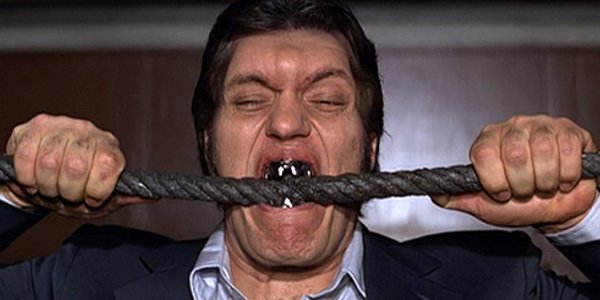
![]() |
| No sweat. Just an average day here. |
In
considering all of this, my chain of thought--for reasons I
cannot remember--led me to the ancient Greek, Roman, and Scandinavian
myths I read in my youth. These myths are generally of two types
(with the exception of creation or cosmological myths). The first are hero myths; stories of a mortal man or woman who dares in some
way to challenge the gods. This, by various stretches of the
imagination, can be considered the form that the vast majority of
cinematic stories follow today. The second type are myths about
the gods themselves, in which mortal men play a minimal or
nonexistent part. These myths are typically broad in scope, yet
fairly shallow in meaning; composed of tales of gods conflicting
with the fickle whims of other deities, supernatural monsters, or
other entities, reaching a conclusion which somehow acts to reclaim
the order and balance of the universe.
The
behavior and personality of James Bond is very much like that found
in the gods of these myths. Bond himself may be considered a
modernized depiction of a god character for several reasons. The
first is the effortless skill with which he achieves all things.
Second, like a god, his character is eternal and unchanging (the
actors who play him may change, but the character essentially remains
the same). Third, unlike most movie heroes, Bond has an implied
immortality. In most action sequences, dramatic tension emerges
from the audience's fear that the hero will meet serious harm.
However, this fear is never truly present in the Bond films. The
audience is always certain that James Bond will find a way to survive
no matter how threatening the situation. Finally, and most
importantly, Bond never struggles with any kind of questions, ethical
or otherwise, regarding his actions. He seems to instantly know the
correct path and takes it as if by supernatural instinct.
![]() |
| Oh, please. You're only amusing him. |
![]() |
| gods... |
| and monsters... |
Of
course, a theory requires more than one example to hold any water.
God narratives are rare, but others do exist. The 1966 Western The
Good, the Bad, and the Ugly
follows the samesuch form. Its protagonist (played by Clint
Eastwood), a man with no name but the nickname
“Blondie,” is another god-hero.
"Blondie" is endlessly capable, endlessly confident, and devoid of strong emotion or moral quandaries. The fact that, unlike Bond, Blondie is a self-serving antihero concerned only with his own wealth does not taint the argument. If one remembers their mythology, it should be recalled that while some gods are benign or hostile towards mankind, most are indifferent to the existence of man and its morality, acting largely to serve their own pleasures. Indeed, Blondie behaves as if he is both outside and above the world of the common man. Neither their worries, their causes, nor even their law are of any concern to him. His only real struggles comes from the constant tricks and treachery played on him by the story's two other larger-than-life beings; the impish trickster Tuco and the shape-shifting devil Angel Eyes – two characters with their own mirrors in mythology.
Blondie's character does not change. Like a deity, his character is eternal and unchanging. This is principally because he had no need to change. Blondie's physical abilities are already perfect, therefore no flaw could exist to interfere with them. As an “idealized being” of his place and time, he essentially lacks nothing. So, unlike a traditional hero, he has no Internal Need which he must pursue to improve as an individual. In times of trouble, Blondie never needs to question whether his past behavior is to blame or seek moral guidance in the future. Each event is merely another up or down in an eternal battle of good and evil. Even when things are at their worst, Blonde is usually rescued by some random twist of fate, suggesting that there is some cosmic order in which he hold a part.
"Blondie" is endlessly capable, endlessly confident, and devoid of strong emotion or moral quandaries. The fact that, unlike Bond, Blondie is a self-serving antihero concerned only with his own wealth does not taint the argument. If one remembers their mythology, it should be recalled that while some gods are benign or hostile towards mankind, most are indifferent to the existence of man and its morality, acting largely to serve their own pleasures. Indeed, Blondie behaves as if he is both outside and above the world of the common man. Neither their worries, their causes, nor even their law are of any concern to him. His only real struggles comes from the constant tricks and treachery played on him by the story's two other larger-than-life beings; the impish trickster Tuco and the shape-shifting devil Angel Eyes – two characters with their own mirrors in mythology.
Blondie's character does not change. Like a deity, his character is eternal and unchanging. This is principally because he had no need to change. Blondie's physical abilities are already perfect, therefore no flaw could exist to interfere with them. As an “idealized being” of his place and time, he essentially lacks nothing. So, unlike a traditional hero, he has no Internal Need which he must pursue to improve as an individual. In times of trouble, Blondie never needs to question whether his past behavior is to blame or seek moral guidance in the future. Each event is merely another up or down in an eternal battle of good and evil. Even when things are at their worst, Blonde is usually rescued by some random twist of fate, suggesting that there is some cosmic order in which he hold a part.
Like
the Bond films, the conclusion of The Good, the Bad, and
the Ugly does not suggest that
the hero's adventures have wrapped up and come to an end as they do
in most feature films. This story seems only to have been a brief episode in an
endless saga which will continue for the hero, though we never get to see most of it. The film's end is merely a pause in the
existence of its unchanging god-hero.
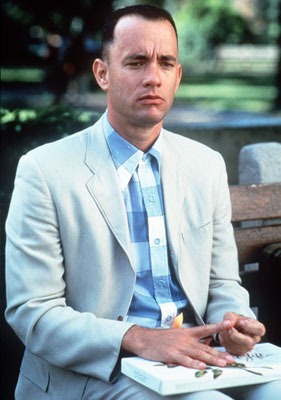
A god narrative of a far difference character can be found in Forrest Gump. While The Good, the Bad, and the Ugly presents only a few episodes in a suggested saga, Gump shows its hero's saga in it near entirety. Gump's narrative presents a very non-traditional structure composed of a series of adventurous episodes, one after another. The only thread which holds Gump together into anything suggesting a traditional three-act form is the one story element which never changes: Forrest's continuing desire to find Jenny and make her his love. The rest of the film, in its epic saga form, depicts little more than the many ways an immortal god-hero like Forrest chooses to fill his time while waiting to meet his Jenny again.
It
might be difficult to imagine Forrest as a god-hero. However, his
character demonstrates the same non-traditional qualities as James
Bond or Blondie. First, by way of his slow-witted and simple
nature, Gump perpetually exists outside of the world of the common
man. He walks among them, but he is not one of them. Forrest's
simple-mindedness actually has the effect of elevating him above
others into a virtuous being. He cannot lie. He cannot hate. He cannot
understand the petty arguments, prejudices, greed and anger which
often consume the common mortal's life. He can almost be considered a
being without sin. Second, one cannot deny that Forrest's physical
skills border on the supernatural. He has the speed to become a
college football All-American with no major effort. He has the
strength to carry five Army buddies to safety. He becomes a
world-class ping pong player only months after first picking up a
paddle. He's the only captain with the skill to keep his shrimp boat
from being destroyed in a hurricane. The examples go on and on.
Third, Forrest has an implied immortality, both in a physical and
a metaphysical sense. He is not only immortal in body, as he survives
Vietnam and the hurricane, but immortal in spirit. As the decades
pass, Gump's exploits pop up in the national media again and again,
as if he were some sort of cosmic thread uniting American
history. Fourth and most importantly, like Bond and Blondie, Forrest
never suffers any ethical dilemma or confusion over what actions to
take. Thanks to his simple mind and pure heart, he does not think; he
simply does and always comes out in the right.
![]() |
| Isn't it weird how I keep showing up at these things? |
As
a character, Forrest Gump does not have any fatal flaw which he must
overcome. Though his naivete and childish innocence do pose
difficulty, this
is not a fatal flaw in the traditional sense. First, this behavior is part of
Forrest's innate nature; a trait which cannot be changed.
Second, this “flaw” is actually Forrest's greatest virtue, since
his innocent mind is the tool which leads him time and again down the
correct paths to overcome conflicts and succeed with hardly any
effort.
The
Bond franchise, The Good, the Bad and the Ugly
and Forrest Gump. Here
we have three examples of highly-successful films of non-traditional
structure in which the protagonists all share the same unusual heroic
traits. These successes are not freak occurrences in the one-and-only
monostructure of cinematic storytelling, but evidence which suggests an
alternate form of structure; one with significant parallels to the god narratives of myth – perhaps even providing a
modern evolution of these tales. However, any further understanding
of this structure and how it functions will require further
investigation and hopefully uncover many more examples of its type.
Sunday, November 23, 2014
New CS Article! -- "Visceral Storytelling"
Though new articles have been slow in coming here on scribbler, please check out my most recent article published in Creative Screenwriting Magazine!
The article introduces the cinematic audience's three levels of psychological need; the intellectual, the emotional, and the visceral; and then uses a popular theory on human brain evolution to explain why this is and why, among the three needs, the visceral is most important when it comes to providing an exciting and dramatically-satisfying story experience. A must-read for any dull script that cannot seem to grab reader excitement in the way it should.
Subscribe to:
Posts (Atom)